Part 2: AI as Ethiopia’s Accelerator—Leapfrogging Development in Core Sectors

2025-Dec-157 mins • Naol Adugna

Part 2: AI as Ethiopia’s Accelerator—Leapfrogging Development in Core Sectors
I

In Part 1, we explored Ethiopia’s widening digital divide and the urgent need for a faster path to technology adoption. Traditional digitization alone is too slow for a world advancing at the pace of Artificial Intelligence. Ethiopia’s opportunity lies in using AI as a leapfrog technology—one that bypasses literacy, language, and infrastructure barriers to deliver immediate value. This article focuses on how AI is already being applied in Ethiopia’s most critical sectors: agriculture, healthcare, and education.

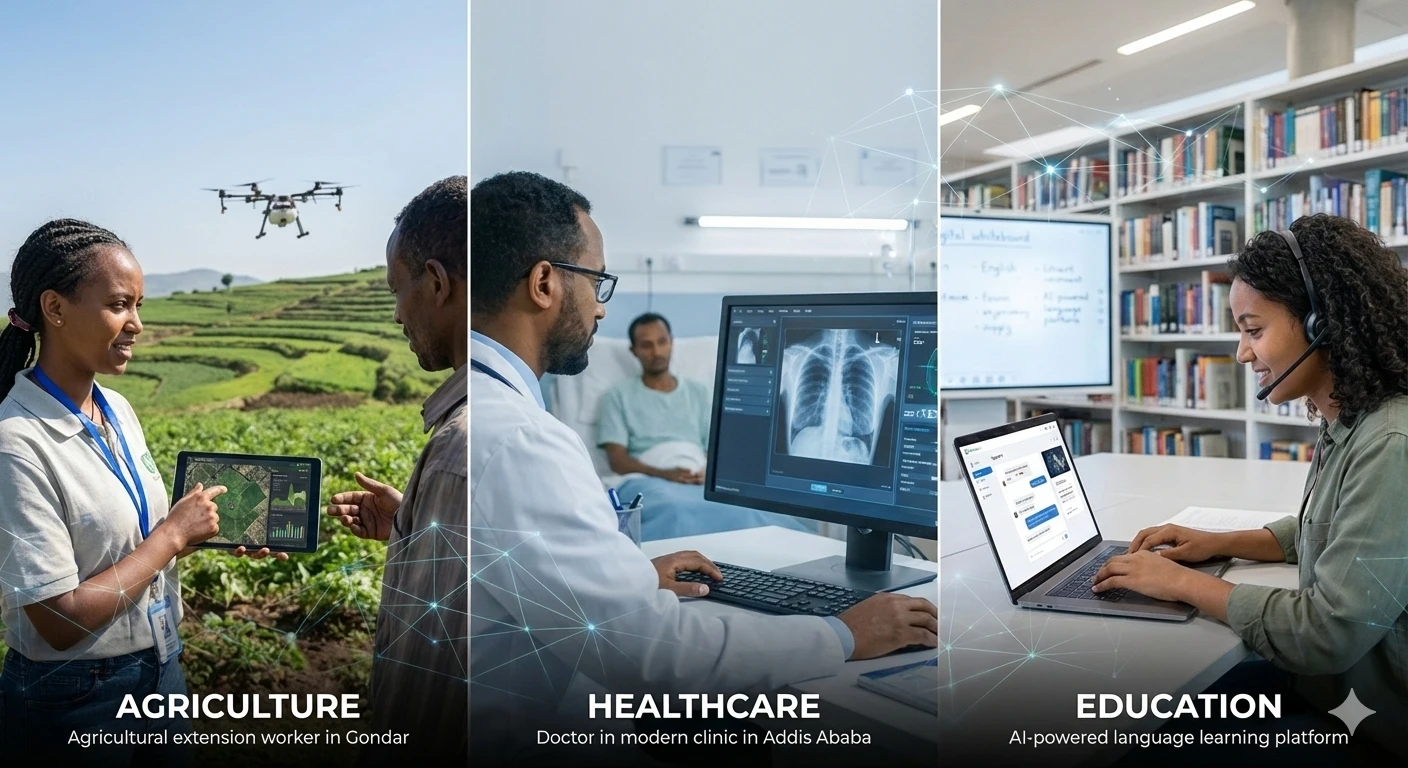
Agriculture employs the majority of Ethiopians, yet farmers often depend on generalized and outdated advice. AI is transforming this reality by delivering localized, data-driven guidance directly to smallholder farmers. Through voice-based and text-based AI assistants in local languages, farmers can access expert advice on crop diseases, planting schedules, and climate-smart practices without needing advanced digital skills.

AI is also enabling precision agriculture by analyzing satellite imagery, soil data, and historical trials to generate site-specific fertilizer and water recommendations. This shift away from blanket approaches improves efficiency, reduces costs, and has already demonstrated significant yield improvements in pilot regions.

In healthcare, Ethiopia faces a shortage of specialists, especially in rural areas. AI-assisted diagnostic tools are helping bridge this gap by supporting frontline health workers. AI models integrated into portable medical devices can rapidly screen for diseases such as tuberculosis and pneumonia, enabling faster diagnosis and treatment where doctors and radiologists are scarce.

Beyond diagnostics, AI-powered systems are improving patient triage, remote monitoring, and resource allocation. These tools help healthcare workers prioritize critical cases, manage limited supplies, and deliver more consistent care across underserved communities.

Education remains another area where AI is delivering outsized impact. Ethiopia’s linguistic diversity and uneven access to quality teaching materials have long hindered learning outcomes. AI-powered educational platforms can generate personalized content in local languages, adapt lessons to individual student needs, and support teachers with administrative tasks, allowing more focus on instruction and mentorship.

Immediate AI-Driven Benefits in Core Sectors
  • ➩ Local-language agricultural advice accessible via voice and simple text
  • ➩ Increased crop yields through AI-driven precision farming
  • ➩ Faster disease detection using AI-assisted diagnostics
  • ➩ Personalized education content in Amharic, Afaan Oromo, and Tigrinya
  • ➩ Reduced administrative workload for educators and health workers
Pillars of Ethiopia’s AI Leapfrog Strategy
  1. ➩ Prioritize AI systems that support local languages and voice interaction
  2. ➩ Use AI to augment frontline workers rather than replace them
  3. ➩ Leverage national data for smarter policy and resource allocation
  4. ➩ Deploy personalized AI services at scale across sectors
  5. ➩ Establish ethical and secure AI governance frameworks
The AI revolution in Ethiopia is not about technological complexity; it is about making advanced knowledge accessible to everyone.- Naol Adugna
Conclusion

AI is proving to be Ethiopia’s most powerful accelerator for development. By scaling expert knowledge, overcoming language barriers, and personalizing services, AI is rapidly increasing productivity and digital awareness across key sectors. However, this progress must be secured. As digital systems expand, so do cyber risks. In the final part of this series, we will examine how Ethiopia can protect its AI-driven future through stronger cybersecurity strategies.

Naol Adugna
Naol Adugna

Naol is a technology professional with a strong focus on Artificial Intelligence and intelligent systems. He is dedicated to exploring, building, and applying AI solutions that improve efficiency, decision-making, and human potential.

Prev Post
Part 1: The Digital Divide and the Dawn of AI in Ethiopia

© 2024 Naol Adugna.   All rights reserved.