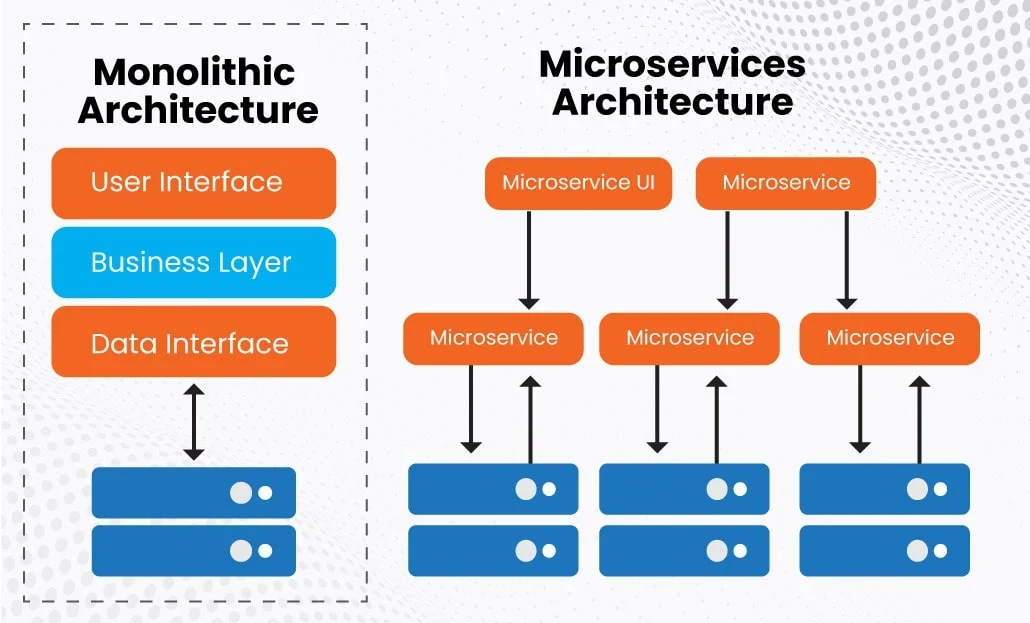
TThe transition from monolithic architectures to microservices has been a defining evolution in web development. This shift is reshaping how modern software systems are built, deployed, and scaled. In this blog post, we explore the key differences between monolithic and microservices architectures, their pros and cons, and how they are transforming web development today.
Web development has seen significant changes over the past decade, particularly in how software architectures are designed. Monolithic architectures, once the norm, have gradually given way to microservicesbased approaches. While monolithic applications bundle all their features into a single, unified codebase, microservices break down functionality into smaller, independently deployable services. This shift brings with it numerous benefits, but also new challenges.
One of the most significant developments in this shift has been the rise of serverless platforms. These platforms simplify deployment by removing the complexities of infrastructure management. Developers no longer need to worry about configuring and maintaining servers, as the cloud provider automatically handles scaling, provisioning, and resource management. This streamlining of deployment allows developers to focus on the application itself, reducing the overhead of managing infrastructure.
In addition to simplifying deployment, serverless platforms have a major financial benefit: they help reduce costs. Traditional serverbased models often require businesses to pay for a fixed amount of server capacity, regardless of whether it's fully utilized. Serverless computing, on the other hand, operates on a payasyougo model. Users are only charged for the resources consumed during application execution, leading to more efficient cost management and avoiding the need for businesses to overprovision resources.
Furthermore, serverless platforms offer dynamic scalability. Resources automatically adjust to match demand, meaning your application can handle varying traffic loads without manual intervention. This is particularly important for modern applications that experience traffic spikes and periods of heavy usage.
However, despite its many advantages, serverless computing is not without its challenges. One of the primary concerns is cold start latency. Serverless platforms typically spin up new instances of services as needed, which can result in latency delays when the system is initially loaded. Managing these latency issues, as well as ensuring optimal resource allocation, requires careful planning and monitoring.
Key Differences Between Monoliths and Microservices
- ⇢ Monoliths are easier to deploy initially but harder to scale.
- ⇢ Microservices offer modularity but come with increased complexity.
- ⇢ Monoliths require fewer resources to manage.
- ⇢ Microservices facilitate independent deployments.
- ⇢ Monolithic applications have simpler debugging processes.
- ⇢ Microservices enable technology diversity across services.
Steps to Transition to Microservices
- ⇨ Analyze existing system bottlenecks and identify pain points.
- ⇨ Identify components to decouple and prioritize by business value.
- ⇨ Set up a service orchestration platform like Kubernetes or Docker Swarm.
- ⇨ Implement API gateways for service communication.
- ⇨ Establish monitoring and logging infrastructure.
- ⇨ Gradually migrate services, starting with the least critical ones.
- ⇨ Monitor and optimize microservices performance continuously.
When considering a migration to microservices, it's crucial to understand that this is not just a technical decision but a strategic one that affects your entire organization. The transition requires careful planning, team training, and a shift in mindset from monolithic thinking to distributed systems thinking.
The choice between monolithic and microservices architectures is not a simple onesizefitsall decision. It's important to evaluate the needs of your specific project, considering factors like scalability, complexity, and cost. Microservices offer more flexibility, scalability, and resilience, but they also introduce new operational complexities that require expertise to manage effectively. Ultimately, the decision to use monolithic or microservicesbased architecture depends on your unique requirements, team size, and longterm goals. Both architectures have their place in modern web development, and the future likely holds a hybrid approach where both paradigms coexist to provide the most efficient and scalable solutions for businesses of all sizes.